What to Do After a Tree Is Removed: Your Complete Next Steps Guide
The tree is down. The crew has packed up and driven away. Now you are standing in your yard looking at a stump, a cleared patch of ground, and probably a few questions about what happens next. Tree removal is rarely the last step in the process: what you do in the days and weeks after a tree comes down makes a significant difference to the long-term health of your landscape, the safety of your property, and the value of the space you have just freed up.
At SYS Tree Service, we have been serving homeowners across Charlestown, Indiana, and the greater Louisville metro area for over 27 years. In that time, we have answered every imaginable post-removal question. This guide covers everything you need to do after a tree is removed: from the stump sitting in your yard to replanting, soil recovery, landscaping, cleanup, and making sure your property stays safe and healthy for the long term.
Step 1: Assess the Site Immediately After Removal
The first step after a tree is removed is to carefully inspect the site and the surrounding area. Even after a professional removal, a thorough post-removal site assessment is worth doing yourself before moving on to the next steps.
Check for Debris and Hazards
Walk the entire area where the tree stood and where it was felled. Look for any remaining debris: small branches, wood chips, splinters embedded in the lawn, or any surface damage to fencing, paving, or landscaping features nearby. Lingering debris can be a trip hazard and can also cause issues if left to decompose on paved surfaces or near other plants.
Check Nearby Structures and Trees
Tree removal, especially of larger trees, can sometimes cause minor damage to nearby structures or affect adjacent trees. Check your fence lines, gutters, nearby garden beds, and the canopy of neighboring trees for any damage or fallen limbs that were not part of the primary removal.
Photograph the Site
Take photos of the site immediately after removal. This is useful for insurance records, for planning your next landscaping steps, and as a baseline reference. If the removal was related to a storm event or insurance claim, post-removal documentation is particularly important.
Step 2: Decide What to Do with the Stump
Unless stump grinding was included in your original removal contract, you are likely left with a stump sitting in the ground. This is one of the most common post-removal decisions homeowners face, and leaving the stump in place is almost never the best option. Here is why, and what your choices are.
Why You Should Remove the Stump
- Stumps are a tripping hazard, especially when partially hidden by new grass or ground cover.
- Decaying stumps attract wood-boring insects, termites, and carpenter ants that can spread to nearby healthy trees and wooden structures on your property.
- Fungal decay in a stump can spread through the soil and root system to neighboring trees, introducing disease to an otherwise healthy landscape.
- A stump and its decaying root system take up valuable ground space and can interfere with new planting, lawn mowing, and landscaping work.
- An unsightly stump reduces the visual appeal and perceived value of your property.
Stump Grinding: The Best Solution
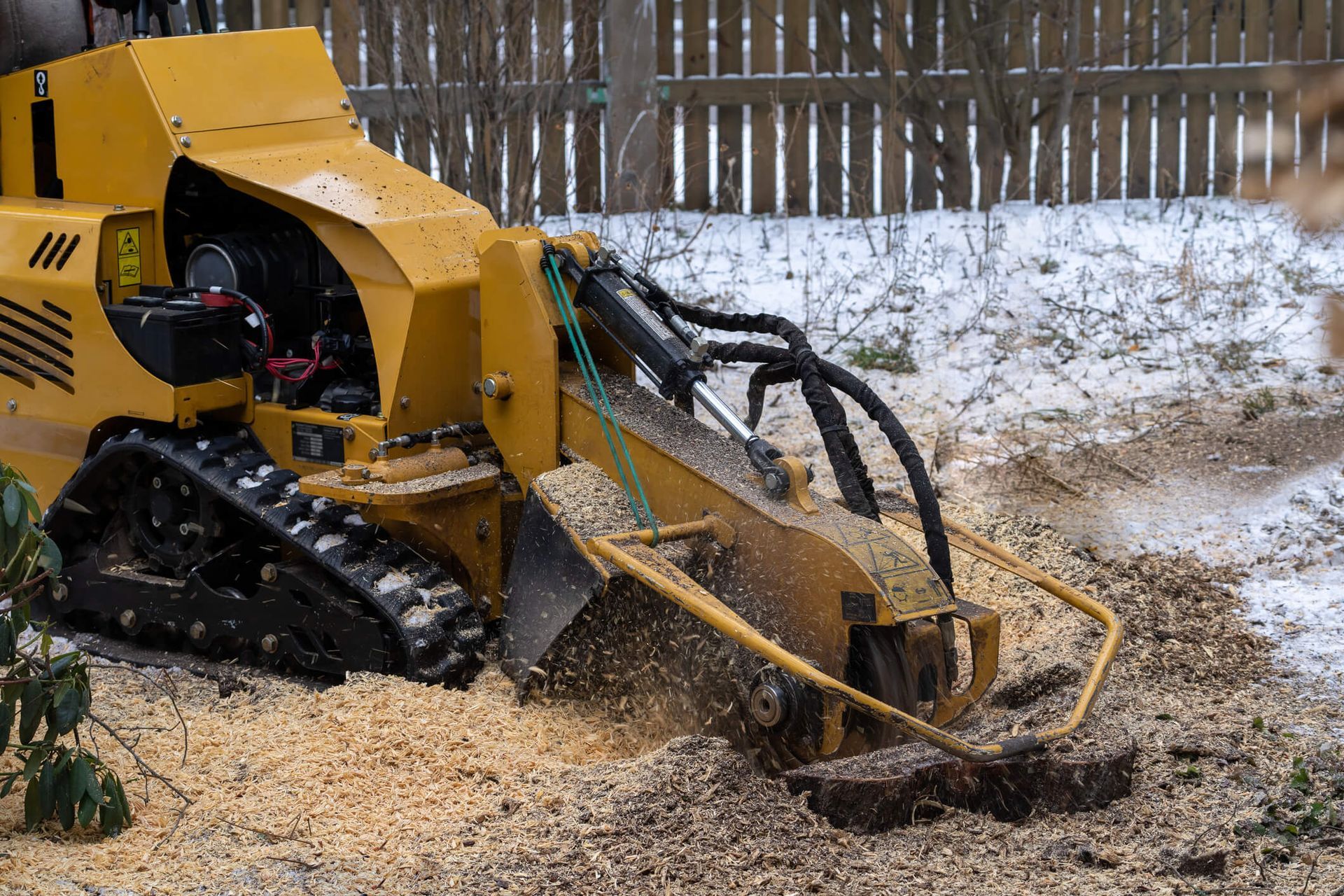
Stump grinding is the most efficient and effective way to deal with a leftover tree stump. A professional stump grinder removes the stump down to below ground level, turning it into wood chip mulch that can be used elsewhere in your landscape or removed entirely. The process is fast, clean, and leaves the area ready for replanting or landscaping within a short time.
When you are ready to schedule, visit our stump grinding service page for more details.
How Soon After Removal Should You Grind the Stump?
In most cases, the sooner you schedule stump grinding after tree removal, the better. A fresh stump is easier to grind than one that has been left for months and has begun to harden or crack unpredictably. However, the stump does not need to be ground on the same day as the removal: scheduling it within the same week or the following week is ideal.
Planning tip: If you are also planning to replant in the same area, read our guide on how soon after stump grinding can you plant before you finalize your landscaping timeline. The wood chip mulch left behind after grinding can affect soil chemistry for a period of time if not properly managed.
Step 3: Understand What Is Happening Underground
When a tree is removed, the visible above-ground portion is gone, but the root system remains fully intact underground unless specific steps are taken to address it. Depending on the size and species of the tree, those roots can extend a significant distance from the trunk and continue to decompose over time.
What Happens to the Roots After Removal
Tree roots do not simply die and disappear the moment the trunk is removed. Some species, particularly certain hardwoods and fast-growing trees, will continue to produce new shoots and sprouts from the root system for months or even years after the tree is removed. These are called root suckers, and they can be a persistent nuisance if not managed. If you are seeing new green growth emerging near the stump or in the surrounding lawn area after removal, this is almost certainly root sucker activity. They should be removed by cutting or treated with a stump killer product to prevent continued regrowth.
The decaying root system also affects the soil around it. As larger roots break down, they can leave voids beneath the surface, which may cause the ground to sink or become uneven over time.
Managing Surface Root Suckers
The most effective way to prevent ongoing root sucker growth is to have stump grinding performed promptly after removal. By grinding the stump below ground level and disrupting the main root crown, you significantly reduce the energy source that drives sucker growth. For stumps that were not ground immediately and have begun producing suckers, a combination of physical removal and a herbicide treatment applied to the cut surfaces is typically the most reliable approach.
Step 4: Assess and Restore the Soil
The area where a tree once stood often has soil that is depleted, compacted, or chemically altered compared to the surrounding lawn or garden. Large trees have a significant effect on the soil beneath them: they alter pH levels, compete with other plants for nutrients, and, through their root activity, change the soil's physical structure over time. After removal, some soil restoration work is usually beneficial before replanting.
Soil Testing
Before adding any amendments or planting anything new in the area, consider getting a simple soil test. A soil test will tell you the pH level, nutrient profile, and organic matter content of the soil, which in turn tells you exactly what amendments are needed. Purdue University Extension offers Indiana-specific guidance on soil testing and amendments, which is directly relevant to homeowners in Charlestown and southern Indiana.
Common Soil Issues After Tree Removal
- High carbon content from decaying wood chips and roots can temporarily tie up soil nitrogen, making it less available to new plants. Allow some time for decomposition, or add a nitrogen-rich fertilizer to compensate.
- Soil compaction from heavy equipment used during removal can reduce drainage and aeration. Aerating the area and adding compost helps restore structure.
- Some species, particularly black walnut and certain conifers, release compounds that inhibit the growth of other plants: this is called allelopathy. If your removed tree was one of these species, allow extra time and add plenty of compost before replanting.

Step 5: Handle the Cleanup and Wood Chip Disposal
After a professional tree removal, the crew will typically clean up the major debris, but the site may still require some additional attention. How you handle the leftover wood, chips, and organic material matters both practically and for the health of your landscape.
What to Do with Wood Chips and Sawdust
The wood chips produced during removal and stump grinding are a genuinely useful landscape resource. Applied as a mulch layer around the base of existing trees and garden beds, wood chips conserve moisture, moderate soil temperature, suppress weeds, and gradually add organic matter to the soil as they break down. The International Society of Arboriculture recommends a mulch layer of 2 to 4 inches deep, spread well away from the base of any trunk to prevent rot. Avoid piling chips directly against plant stems.
What to Do with Larger Wood Sections
- Have the wood cut to firewood length if the tree species is suitable for burning, such as oak, hickory, or maple
- Contact a local sawmill if the trunk sections are large and the wood is high quality: some species have significant lumber value.
- Leave a few larger rounds as natural seating or landscape features.
- Arrange for the removal company to haul away any material you do not want to keep: this is often included in the original service quote, but confirm with your provider.
Step 6: Inspect Your Remaining Trees
Removing one tree changes the conditions for every other tree nearby. More sunlight, altered wind exposure, and changes in root competition all affect how your remaining trees respond in the months following a removal. Use this as an opportunity to do a thorough assessment of your entire landscape.
In particular, look for trees that were previously sheltered by the removed tree and are now exposed to more direct wind. Sudden changes in wind exposure can stress trees that were not structurally adapted to it, making them more susceptible to wind throw or branch failure.
Also consider whether the removal was prompted by disease or pest infestation. If so, inspect all nearby trees carefully for signs that the same issue has spread. Early detection is critical.
If there are trees on your property that you have not had professionally assessed recently, this is an ideal time to schedule a full inspection.
Step 7: Plan Your Replanting Strategy
Once the stump is ground, the soil is assessed, and the site is cleaned up, you are ready to think about what to plant in the space the tree has left behind. This is one of the most rewarding steps in the post-removal process, and getting it right makes a real long-term difference to your property.
Should You Plant Another Tree in the Same Spot?
In many cases, yes, but not immediately and not necessarily the same species. There are a few important considerations before replanting a tree in the exact location of the removed one:
- Allow at least several months after stump grinding for the remaining root material to begin decomposing before planting a new tree in the same hole.
- If the original tree was removed due to disease, avoid replanting the same species or a closely related one in that spot until the soil has been tested and any residual pathogen pressure is confirmed to be resolved.
- Consider whether the original tree's size was appropriate for the space. Many homeowners use the opportunity to choose a smaller or more suitable species that will not create the same problems in the future.
Ground Cover and Shrubs as an Alternative
Not every space left by a removed tree needs to be filled with another tree. In some locations, particularly where a large tree was removed near a structure, or where overhead clearance is limited, ground cover plants, ornamental shrubs, or a new lawn area may be a better choice. These options can be planted sooner after stump grinding than a new tree and can transform the cleared space into an attractive landscape feature.
Timing Your Replanting
For Indiana, the best planting seasons for new trees are spring and fall, when temperatures are moderate, and rainfall is more reliable. Avoid planting in the heat of summer or when the ground is frozen. Our seasonal tree care guide covers the optimal timing for all major tree care activities throughout the year in the Indiana and Louisville metro climate.
Step 8: Repair the Lawn and Surrounding Area
Heavy equipment, foot traffic, and the removal process itself can leave the lawn and surrounding ground in rough shape. Lawn repair after tree removal is a straightforward process, but it benefits from being done the first time correctly.
- Remove any remaining surface roots, large wood chip concentrations, or debris from the lawn area.
- Fill any significant depressions or voids in the ground with quality topsoil, tamping it down gently to eliminate air pockets.
- Loosen and aerate the compacted soil in the footprint of the removal work using a garden fork or mechanical aerator.
- Add a thin layer of compost over the repair area to improve soil structure and nutrient content before seeding.
- Seed the area with a grass variety appropriate for Indiana conditions: fescue blends generally perform well in southern Indiana's climate.
- Water consistently and keep foot traffic off the newly seeded area until the grass is well established.
If the area under the tree was previously bare due to heavy shade, the newly open ground will need some time to establish good grass coverage. Be patient, and consider whether a shade-tolerant grass variety or ground cover plant might better suit the spot than a standard sun-loving lawn grass, particularly if nearby trees still cast significant shade.
Step 9: Confirm Permits Are Closed, and Records Are Updated
If your tree removal required a permit, confirm with your local municipality that the permit has been properly closed now that the work is complete. In some Indiana municipalities, there are specific completion requirements, such as replanting obligations or inspection sign-offs before a permit is formally closed. Failing to complete these steps can result in fines or compliance issues down the line.
For full guidance on Indiana's tree removal permit requirements and how they vary by municipality, read our post on Do You Need A Permit to Cut Down a Tree in Indiana.
If the removal was covered wholly or partially by homeowners' insurance, update your insurance records to reflect the change in your property. In some cases, the removal of a large tree may actually affect your property risk profile and could be relevant to your premium at renewal.
Step 10: Set Up an Ongoing Tree Care and Maintenance Plan
The post-removal period is an excellent time to step back and consider the long-term maintenance strategy for your entire property's tree canopy. Many homeowners who face expensive or urgent tree removal situations could have avoided them, or at least managed them more cost-effectively, with a proactive maintenance approach.
Regular professional tree care pays for itself many times over. Routine inspections, timely pruning, and early identification of disease or structural issues all extend the life of your trees and dramatically reduce the risk of emergency situations. Explore our full range of guidance on this topic:
- Benefits of regular tree maintenance
- How to maintain healthy trees
- Tree maintenance checklist
- Tree care checklist for homeowners
- Tree pruning techniques guide
- Tree watering tips
The International Society of Arboriculture provides excellent homeowner resources on all aspects of tree care and maintenance, and their certified arborist locator can help you find credentialed professionals in your area whenever you need a second opinion or a specialist assessment.
When to Call SYS Tree Service After Your Tree Removal
Our relationship with customers does not end when the tree comes down. There are several common post-removal situations where calling your tree service is the right next step:
- You notice persistent root sucker growth that is not responding to manual removal.
- The ground around the stump or removal site is sinking, cracking, or showing signs of significant underground voids.
- You see signs of pest activity, such as sawdust trails, bark holes, or insect swarms, near the stump or in adjacent trees.
- A neighboring tree is showing new signs of disease or structural stress following the removal.
- You need stump grinding scheduled, or you want a site assessment before replanting.
- You are planning significant new planting or landscaping, and want a professional assessment of soil conditions and tree placement.
SYS Tree Service serves Charlestown, Indiana, and the greater Louisville metro area, Monday through Friday, 6:30 am to 5:00 pm. For any post-removal questions or to schedule stump grinding or a follow-up site assessment, contact our team here or call us directly at 502-724-6950. For urgent tree issues, see our emergency tree removal services.
Frequently Asked Questions: After Tree Removal
How long does it take for a tree stump to fully decompose on its own?
It depends on the species, size, and local conditions, but most tree stumps take anywhere from 3 to 7 years to fully decompose on their own. Hardwood stumps, such as oak or hickory, take longer than softwood species. During that time, the stump remains a pest attraction, a tripping hazard, and a source of ongoing root sucker growth. Stump grinding is almost always preferable to waiting for natural decomposition.
Can I plant grass directly over a ground stump or wood chips?
You can, but it is not ideal right away. Wood chip material left after stump grinding temporarily depletes soil nitrogen as it breaks down, which can inhibit grass establishment. The best approach is to remove the bulk of the wood chip material first, add quality topsoil and compost, then seed. Alternatively, wait 3 to 6 months for the wood chips to begin breaking down before seeding over the area.
Will the tree roots left in the ground cause any problems?
In most cases, the remaining root system will simply decompose over time without causing problems. However, on species that are prone to sucker growth, you may see new shoots emerging for a year or more after removal. If the removed tree was diseased, the decaying roots could harbor fungal pathogens that affect nearby trees. And in some cases, decaying roots can leave voids beneath paved surfaces or near foundations as they break down.
How soon can I replant in the same area?
For ground cover plants and shrubs, you can often replant within a few weeks of removal, assuming the stump has been ground and basic soil preparation has been done. For a new tree in the same spot, it is generally better to wait several months to allow the old root system to begin breaking down and for the soil to stabilize. Read our full guide on how soon after stump grinding can you plant for specific timing guidance.
Is it normal for the ground to be uneven or soft after tree removal?
Yes, this is common, especially after removing a large tree. The removal process disturbs the soil, and as the root system begins to decay underground, minor settling and unevenness in the surface can continue for some time. Fill any significant depressions with topsoil promptly to prevent them from deepening or causing drainage problems. If you notice significant sinking over a larger area or cracking in nearby paving or structures, have a professional assess the site.
Do I need to do anything to prevent the removed tree's disease from spreading?
If the tree was removed due to a fungal disease, bacterial infection, or systemic pest infestation, there are important steps to take to protect nearby trees. Make sure all infected wood and debris are fully removed from the site rather than left to decompose in place. Have nearby trees inspected by a professional. In some cases, a preventive fungicide or pesticide treatment on adjacent trees is warranted.
Final Thoughts: Make the Most of Your Post-Removal Opportunity
Tree removal is rarely just an ending: it is almost always the beginning of something new for that part of your landscape. Whether you are planning to replant, open up the space for a new garden feature, restore the lawn, or simply ensure the site is safe and healthy, the steps you take in the days and weeks after removal have a lasting impact on the outcome.
The most important single step is almost always prompt stump grinding: it eliminates the pest and disease risk, ends sucker growth, and opens the site up for whatever comes next. From there, a thoughtful approach to soil recovery, replanting, and ongoing maintenance will ensure your landscape stays healthy, and your property stays safe for years to come.
At SYS Tree Service, we are here to help at every stage, from the removal itself through to stump grinding, post-removal site assessment, and advice on replanting and ongoing tree care. With over 27 years of experience serving Charlestown, Indiana, and the greater Louisville metro area, we have the knowledge and the equipment to make your post-removal process as smooth as possible.
Ready to schedule stump grinding or a post-removal site assessment? Contact SYS Tree Service today or call 502-724-6950, Monday through Friday, 6:30 am to 5:00 pm.
You might also like