How to Tell If a Tree Is Dead or Just Dormant: A Homeowner's Guide
Every homeowner has been there, you glance out at a tree in your yard and notice it looks bare, brown, or lifeless. But is it actually dead, or is it just dormant for the season? The answer matters a lot. Removing a healthy, dormant tree wastes a valuable asset, while leaving a dead or dying tree standing puts your home, family, and property at serious risk.
At SYS Enterprises, we've served homeowners in Charlestown, Indiana and the surrounding area for over 27 years. One of the most common questions we get is: "Is my tree dead or just sleeping?" This guide will walk you through exactly how to find out.
Dead Tree vs. Dormant Tree: What's the Difference?
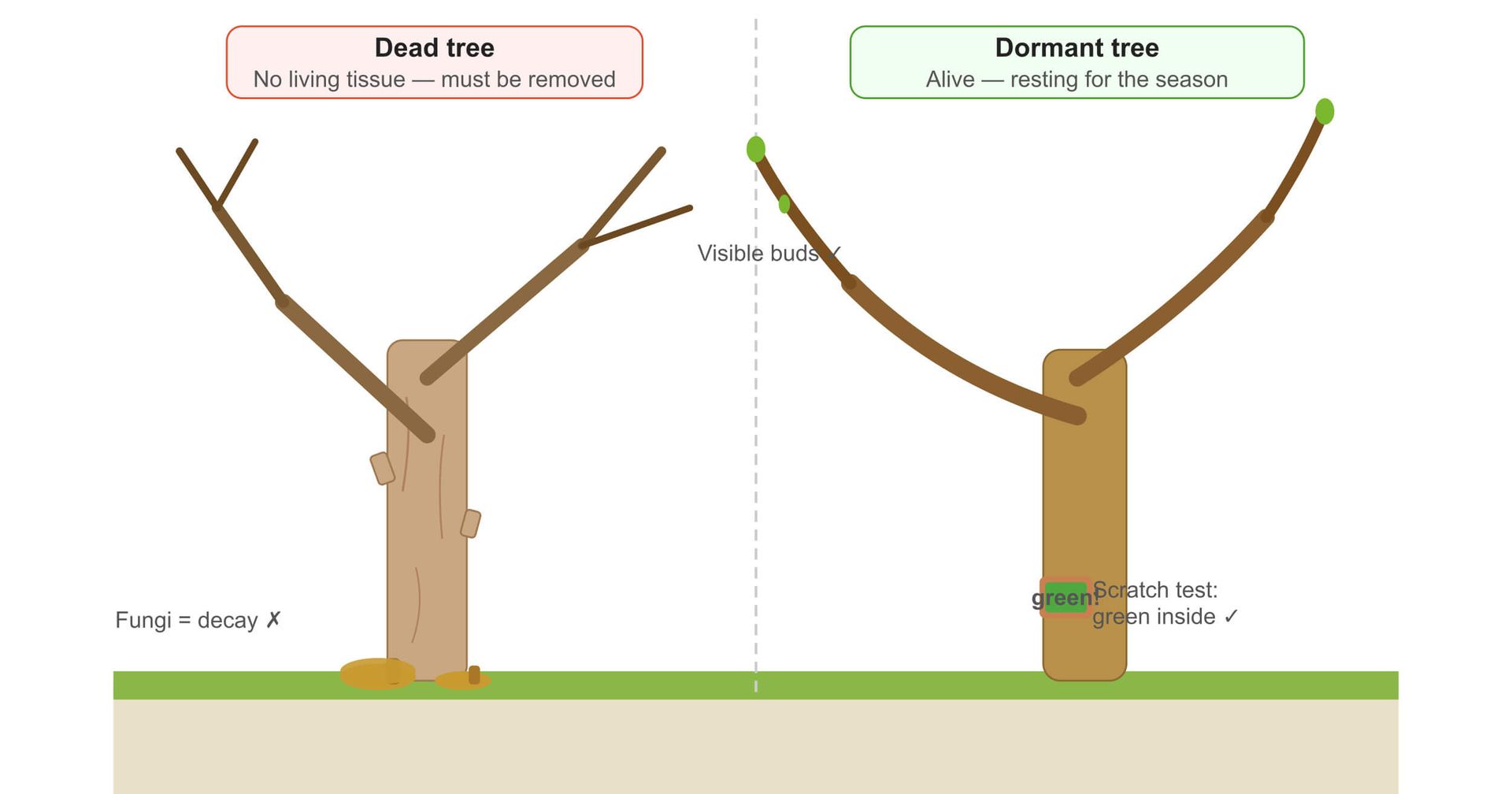
A dormant tree is simply resting. During winter or drought, many trees pause their growth to conserve energy. This is a completely natural, healthy process. Leaves fall, growth slows, and the tree may look dead, but it isn't.
A dead tree, on the other hand, has no living tissue remaining. Its root system has failed, its vascular system is gone, and it will never produce new growth. Dead trees become brittle, unstable, and hazardous very quickly, often faster than homeowners expect.
The tricky part? Both can look nearly identical in winter. That's why it's important to know the specific signs that set them apart.
The Scratch Test: The Easiest Way to Check
The single most reliable DIY test for determining if a tree is dead or dormant is the scratch test. Here's how to do it:
• Step 1: Find a small twig or branch, ideally one between pencil and thumb thickness.
• Step 2: Use your fingernail or a pocket knife to gently scratch away the outer layer of bark.
• Step 3: Look at the layer just beneath the bark (called the cambium layer).
• Green or white and moist = alive. The tree is dormant, not dead.
• Brown, dry, or brittle = dead. That branch and possibly the whole tree has died.
Test several branches in different areas of the tree, including some higher up. A dead branch doesn't always mean a dead tree, but if the majority of branches test brown and dry, you likely have a serious problem.
Visual Signs Your Tree May Be Dead
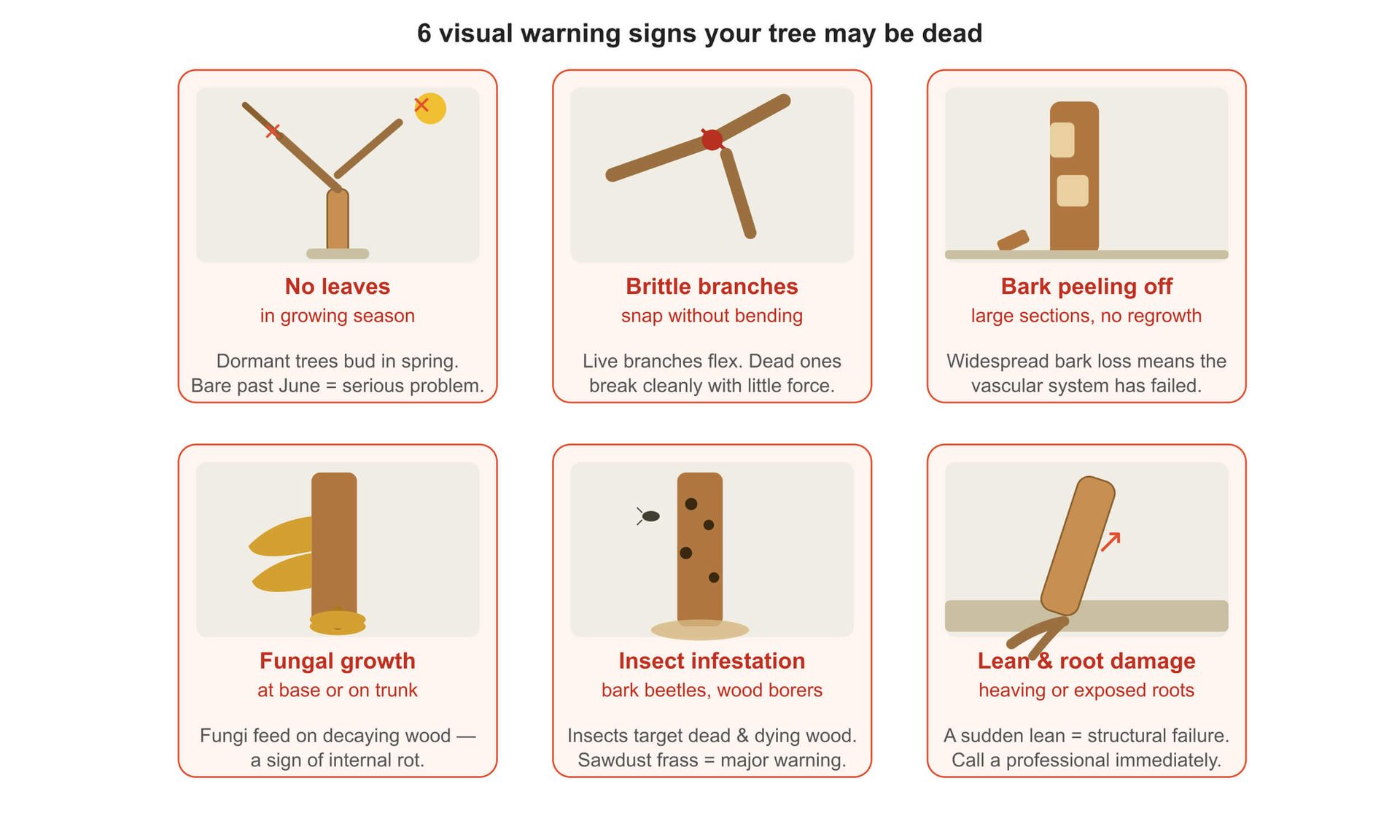
Beyond the scratch test, there are several visual warning signs that a tree has died or is in severe decline:
1. No Leaves During Growing Season
A dormant tree will break bud and produce new leaves in spring. If spring and summer arrive and your tree still hasn't leafed out, that's a major red flag. Deciduous trees that remain bare after their neighbors have fully leafed are almost certainly dead or in serious decline.
2. Brittle, Easily Snapping Branches
Live branches, even on dormant trees, have some flex to them. Dead branches are dry and snap cleanly with little effort. If you bend a branch and it breaks rather than bends, it's dead. Test multiple branches throughout the canopy.
3. Bark That Is Falling Off or Crumbling
Healthy bark protects the living tissue underneath. When bark begins to fall off, crack deeply, or crumble away in large sections without regrowth, it's a sign the tree's vascular system has died. Some bark shedding is normal in certain species, but widespread bark loss is not.
4. Fungal Growth at the Base or on the Trunk
The presence of mushrooms, bracket fungi, or shelf fungi growing at the base or on the trunk of a tree is a sign that wood decay has set in. Fungi break down dead and decaying wood, so their presence usually means significant internal rot has already occurred. This is one of the clearest indicators of a dying or dead tree.
5. Insect Infestations
Certain insects like bark beetles, wood borers, and carpenter ants are attracted specifically to dead and dying wood. If you notice large numbers of these insects or significant sawdust-like frass at the base of the tree, it strongly suggests the tree is in serious decline.
6. Significant Lean or Root Damage
A tree that has developed a sudden lean, or one with heaving, exposed, or damaged roots, may be in structural failure. This can happen even if the tree still has leaves. Root damage affects the tree's ability to take up water and nutrients, often resulting in a slow death from the top down.
For more on visual warning signs, see our post: 10 Warning Signs Your Tree Might Be a Danger to Your Home.
Signs Your Tree Is Dormant (Not Dead)
Beyond the scratch test, there are several visual warning signs that a tree has died or is in severe decline:
1. No Leaves During Growing Season
A dormant tree will break bud and produce new leaves in spring. If spring and summer arrive and your tree still hasn't leafed out, that's a major red flag. Deciduous trees that remain bare after their neighbors have fully leafed are almost certainly dead or in serious decline.
2. Brittle, Easily Snapping Branches
Live branches, even on dormant trees, have some flex to them. Dead branches are dry and snap cleanly with little effort. If you bend a branch and it breaks rather than bends, it's dead. Test multiple branches throughout the canopy.
3. Bark That Is Falling Off or Crumbling
Healthy bark protects the living tissue underneath. When bark begins to fall off, crack deeply, or crumble away in large sections without regrowth, it's a sign the tree's vascular system has died. Some bark shedding is normal in certain species, but widespread bark loss is not.
4. Fungal Growth at the Base or on the Trunk
The presence of mushrooms, bracket fungi, or shelf fungi growing at the base or on the trunk of a tree is a sign that wood decay has set in. Fungi break down dead and decaying wood, so their presence usually means significant internal rot has already occurred. This is one of the clearest indicators of a dying or dead tree.
5. Insect Infestations
Certain insects like bark beetles, wood borers, and carpenter ants are attracted specifically to dead and dying wood. If you notice large numbers of these insects or significant sawdust-like frass at the base of the tree, it strongly suggests the tree is in serious decline.
6. Significant Lean or Root Damage
A tree that has developed a sudden lean, or one with heaving, exposed, or damaged roots, may be in structural failure. This can happen even if the tree still has leaves. Root damage affects the tree's ability to take up water and nutrients, often resulting in a slow death from the top down.
For more on visual warning signs, see our post: 10 Warning Signs Your Tree Might Be a Danger to Your Home.
Signs Your Tree Is Dormant (Not Dead)
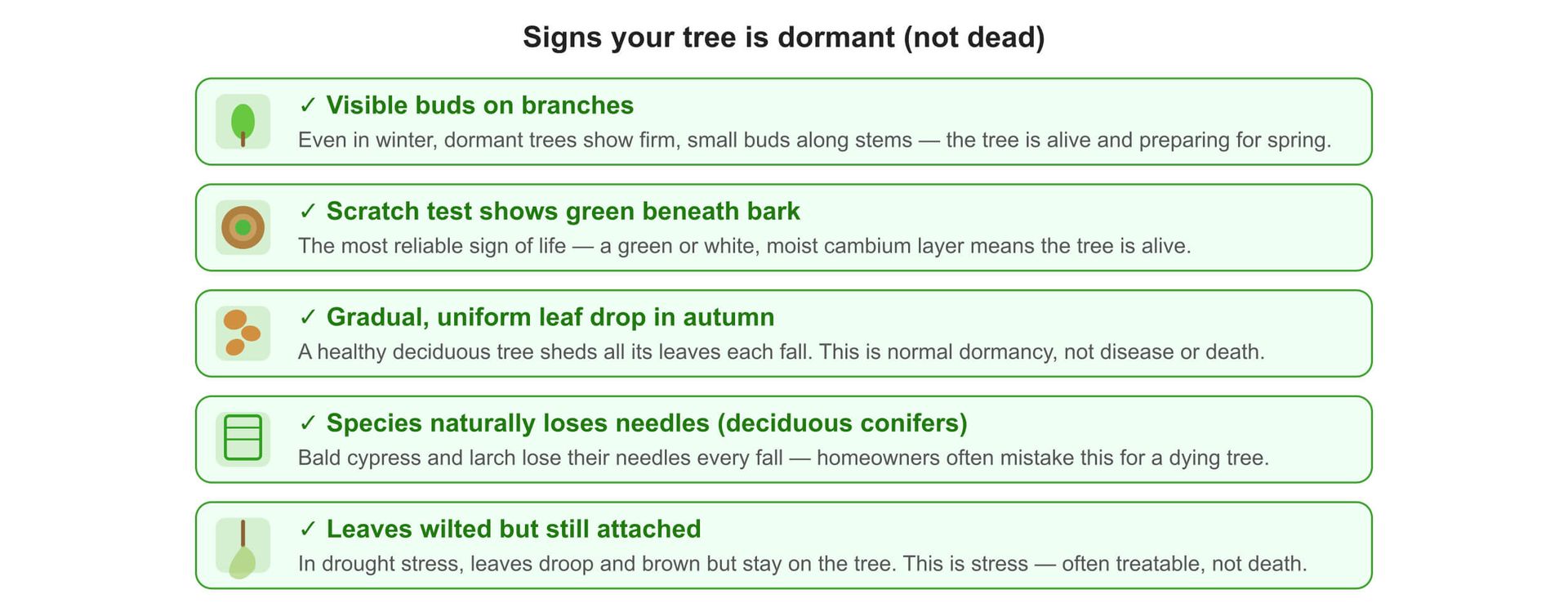
Not every struggling-looking tree is dead. Here are signs your tree is likely just dormant and healthy:
• Buds are present on branches. Even bare trees in winter usually have visible buds. If you can see small, firm buds along the branches, the tree is alive.
• The scratch test shows green. As described above, green or white beneath the bark means living tissue.
• Gradual, uniform leaf drop in fall. This is normal deciduous behavior, not a sign of death.
• Tree has a history of this appearance. Some trees, like bald cypress or larch, are deciduous conifers and lose their needles every year. Homeowners sometimes mistake this for dying.
• Leaves are wilted but still attached. In drought stress, leaves may droop and brown but remain on the tree. This is stress, not necessarily death.
If you're seeing these signs, your tree may just need some care. Our Complete Seasonal Tree Care Guide covers everything homeowners need to keep trees healthy year-round.
How to Identify Hazardous Trees That Need Removal
Whether a tree is dead or severely diseased, a hazardous tree is a liability. Dead trees can drop branches or fall suddenly, often without warning, and sometimes in calm weather. The weight of a large dead tree can cause catastrophic damage to your home, vehicle, or any person nearby.
Key hazard indicators include:
• Dead or hanging branches (widow makers) suspended in the canopy above
• Cracks or splits in the trunk or major limbs
• Hollow trunk, knock on the trunk; a hollow sound indicates internal decay
• Multiple dead tops (the upper canopy has died while lower branches remain)
• Proximity to structures, power lines, or high-traffic areas
Read our full guide: How to Identify Hazardous Trees That Need Removal.
Could It Be a Tree Disease?
Sometimes what looks like a dead or dormant tree is actually a tree in the advanced stages of disease. Common tree diseases, such as Dutch elm disease, oak wilt, fire blight, and various fungal infections, can cause rapid dieback that mimics the appearance of a dead tree.
Signs of disease vs. straightforward death include:
• Partial dieback, one side of the tree or one branch cluster is affected while the rest looks healthy
• Discolored, spotted, or wilted leaves during the growing season
• Cankers or sunken areas on the bark
• Unusual oozing or weeping from the trunk or branches
If you suspect disease, it's important to act quickly. Some diseases can spread to neighboring trees. Learn more in our post: Understanding Tree Diseases Including Symptoms, Causes, and Treatments.
What to Do If You Think Your Tree Is Dead
If your scratch test and visual inspection suggest the tree is dead or severely compromised, here's what to do:
• Don't wait. Dead trees deteriorate fast. What takes months to die can fall in seconds.
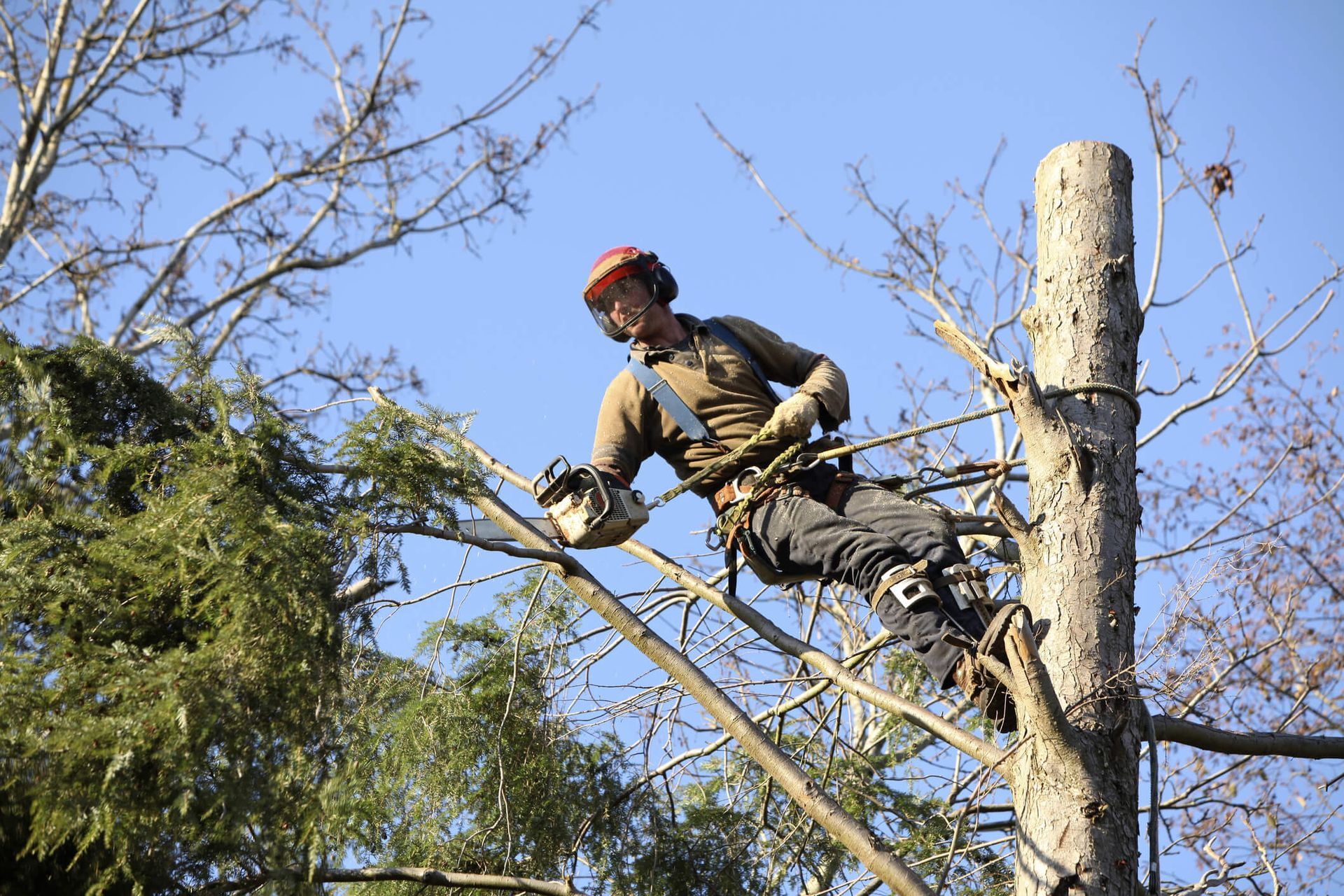
• Don't attempt DIY removal. Dead trees are unpredictable. Removing them safely requires professional equipment and training.
• Call a professional tree service for an evaluation.
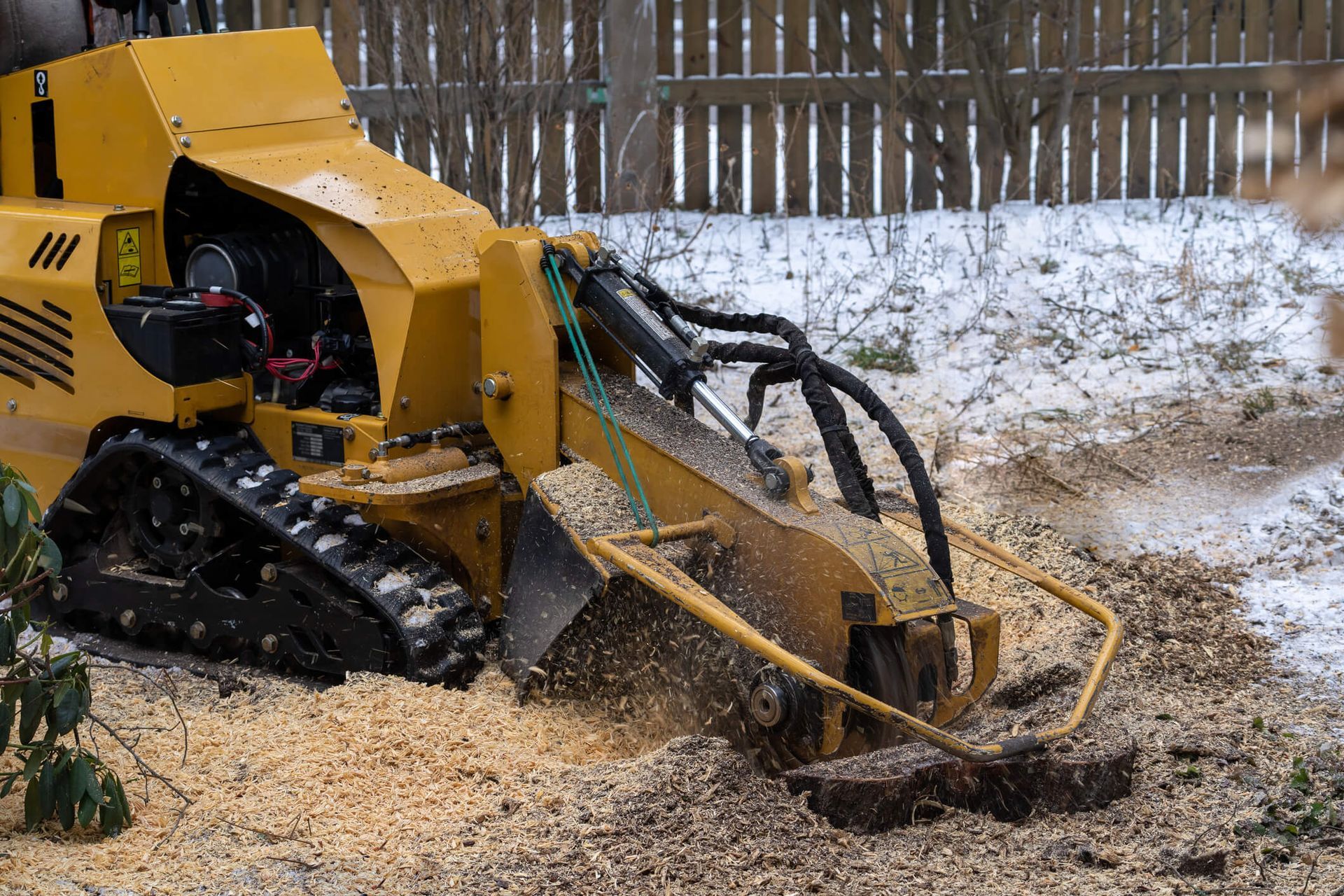
• Ask about stump removal too. Once the tree is down, a leftover stump creates tripping hazards, attracts pests, and can regrow. Learn more: Why Stump Removal Is Important.
Read our guide on the Hidden Dangers of Delaying Tree Removal on Your Property to understand why procrastinating on a dead tree is a serious risk.
DIY Assessment vs. Professional Evaluation: When to Call an Expert
The scratch test and visual checks above are great starting points, but they have limits. A certified arborist or professional tree service can assess your tree much more thoroughly, including:
• Evaluating internal decay that isn't visible from the outside
• Assessing the root system and soil stability
• Determining whether the tree can be saved with treatment or pruning
• Identifying disease or pest infestations
• Providing a safe, accurate removal plan if needed
Curious what a tree professional actually does? Read our post: What Does an Arborist Do?.
And if you're curious about what to expect when getting a removal quote: What to Expect From a Tree Removal Estimate.
When Is a Dead Tree an Emergency?
Some situations require immediate emergency response, not a scheduled appointment:
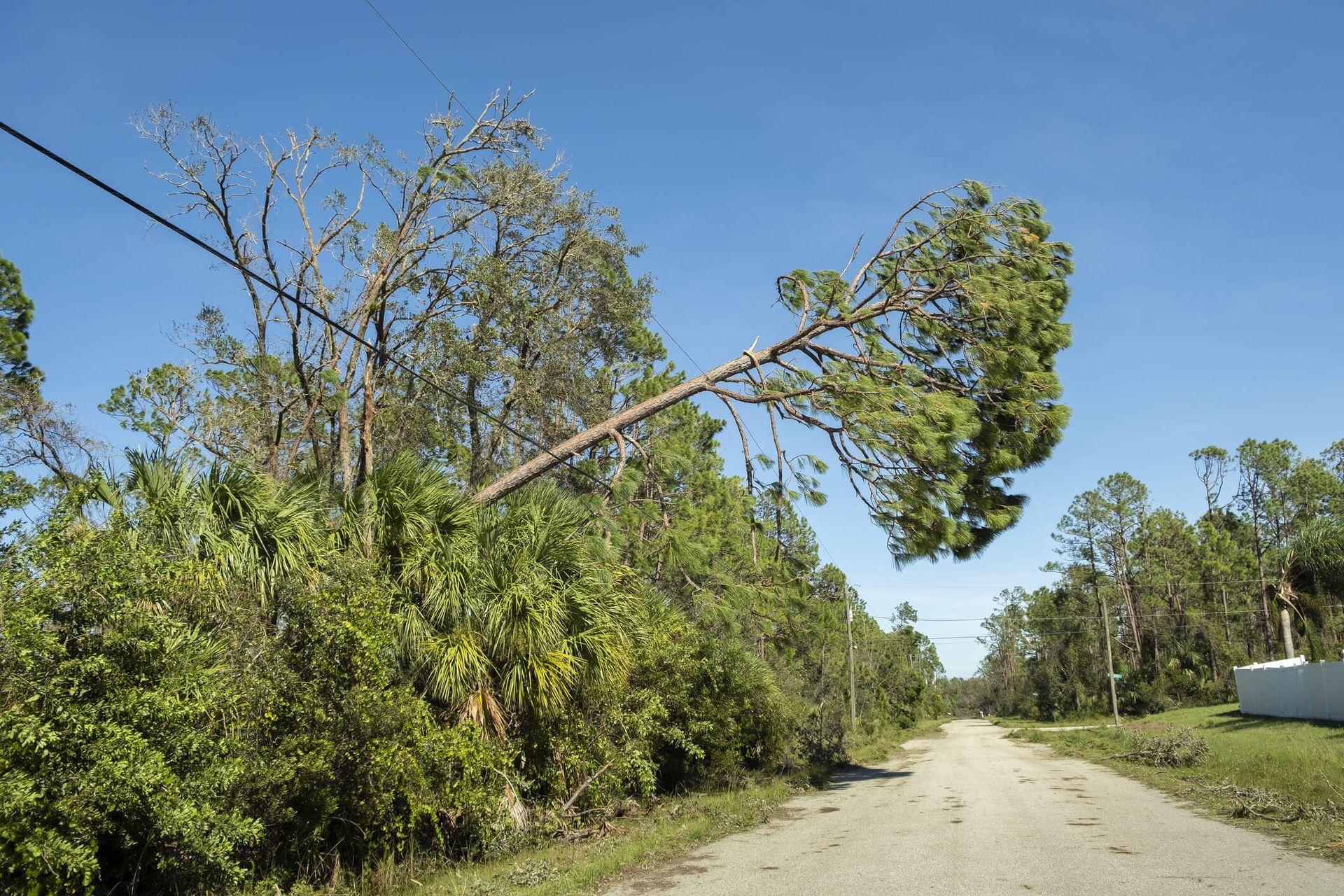
• The tree has already partially fallen or is leaning against your house or power lines
• A major limb has cracked and is suspended overhead
• The tree fell during a storm and is blocking access or causing damage
• The trunk is visibly splitting or separating at the base
SYS Enterprises provides emergency tree removal services for exactly these situations. Don't wait until morning. A compromised dead tree can come down at any time.
See our guide: Signs You Might Need Emergency Tree Removal.
Does Homeowner's Insurance Cover Dead Tree Removal?
This is a common question, and the answer is: it depends on the circumstances. In general, homeowner's insurance may cover tree removal if:
• The dead tree falls on a covered structure (like your home)
• The damage was caused by a covered event like a windstorm or lightning
However, if a tree was visibly dead or diseased and the homeowner failed to act, insurance companies may deny the claim on the grounds of negligence. This is another strong reason to address dead or hazardous trees proactively.
Learn more: Does Homeowner's Insurance Cover Tree Removal?.
Get a Professional Tree Assessment in Charlestown, IN
If you're unsure whether your tree is dead, dormant, diseased, or dangerous, the safest and smartest move is to have it professionally evaluated. The team at SYS Enterprises has over 27 years of experience helping Charlestown, Indiana homeowners protect their properties from hazardous trees.
We offer professional tree removal, emergency tree removal, and stump grinding. We're always happy to take a look and give you an honest assessment.
Call us today at 502-724-6950 or visit our contact page to schedule your evaluation.
Frequently Asked Questions
How do I know if my tree is dead in winter?
Use the scratch test: scrape a small twig and look for green beneath the bark. Also check for buds on the branches. If the cambium is brown and dry and you see no buds, the tree is likely dead, not just dormant.
Can a dead tree come back to life?
No. Once a tree is completely dead, it cannot recover. However, trees that appear dead may actually have some living sections, and a certified arborist can assess whether recovery is possible through targeted pruning and treatment.
How fast does a dead tree become dangerous?
This varies by species and environment, but a dead tree can become a serious hazard within one to two years, sometimes sooner. Decay sets in quickly, weakening the root system and trunk. High winds, heavy rain, or ice can bring a dead tree down unpredictably.
How much does dead tree removal cost in Indiana?
Costs vary depending on tree size, location, and access. See our guide: What Factors Influence Tree Removal Cost in Charlestown, Indiana? Call us for a free estimate.
You might also like